


When Teamwork Makes the Impossible Possible
A Story of Physiology, Courage, and Multidisciplinary Critical Care
Introduction
Every intensivist encounters a few patients during his or her career who redefine the boundaries of what modern critical care can achieve. This was one such patient.
A 38-year-old gentleman sustained two close-range gunshot injuries, resulting in devastating thoracoabdominal trauma. One bullet traversed the abdomen, injuring the stomach, colon, and small intestine, narrowly missed the posterior walls of the aorta and inferior vena cava, and finally exited through the thorax, creating a large bronchopleural fistula. The extent of injury was catastrophic, involving multiple organ systems simultaneously and presenting one of the greatest challenges an intensivist can face.
He underwent emergency damage-control surgery at the referring hospital. The primary objectives were haemorrhage control, contamination control, bullet removal, and stabilisation for transfer. An intercostal drain was inserted for the thoracic injury, and the patient was transferred to our tertiary care ICU approximately 24 hours later.
Although damage-control surgery had been successfully performed, the physiological battle was only just beginning.
Arrival at Our ICU: A Patient in Profound Physiological Collapse
When the patient arrived, he was critically ill and rapidly progressing towards irreversible multiple organ dysfunction.
He remained hypotensive despite ongoing resuscitation, oliguric, and severely acidotic, with an arterial pH of 6.8, reflecting profound tissue hypoperfusion and ongoing shock. Liver function was severely impaired, with SGOT and SGPT exceeding 5,000 IU/L, suggesting ischemic hepatitis (“shock liver”). His coagulation profile was deranged after massive trauma and emergency surgery.
The respiratory challenge was equally formidable.
Due to the large bronchopleural fistula, more than 60% of each tidal volume delivered escaped through the chest drain, rendering conventional positive-pressure ventilation highly ineffective. Every breath delivered by the ventilator was partially lost through the fistula rather than contributing to alveolar gas exchange. Severe hypoxemia, hypercapnia, and ventilator instability became persistent threats.
At this stage, the patient had entered a vicious cycle:
Persistent shock worsened tissue perfusion.
Poor tissue perfusion aggravated metabolic acidosis.
Acidosis impaired myocardial performance.
Ongoing air leak prevented effective ventilation.
Inadequate ventilation further worsened hypoxia and acidosis.
Progressive inflammation increased the risk of irreversible multiorgan failure.
Without rapid physiological correction, survival was unlikely.
The First Decision: Treat Physiology Before Anatomy
Before proceeding with another surgical intervention, it was clear that the patient’s physiology had to be restored.
After detailed discussions with the family, thoracic and vascular surgeons, anesthesiologists, and the ICU team, we explained the extremely grave prognosis. The family showed extraordinary courage and trust. Despite understanding the significant risk of death, they encouraged us to pursue every reasonable intervention.
This unwavering support became one of the strongest pillars throughout the patient’s journey.
Our immediate objective during the next 48 hours was straightforward:
Restore physiology before attempting definitive surgery.
Advanced Hemodynamic Resuscitation
The cornerstone of management was individualised, physiology-guided resuscitation rather than protocol-driven fluid administration.
Advanced monitoring was established immediately:
Invasive arterial blood pressure monitoring
Central venous access
Advanced cardiac output monitoring
Serial bedside ultrasound examinations
Continuous assessment of perfusion markers
Frequent arterial blood gas analysis
Instead of administering large volumes of intravenous fluids empirically, every intervention was guided by dynamic physiological parameters. Repeated bedside ultrasonography senabled assessment of cardiac function, preload, ventricular filling, inferior vena cava dynamics, pulmonary congestion, and response to therapy. Cardiac output monitoring enabled continuous optimization of preload, afterload, and myocardial performance while avoiding both hypovolaemia and fluid overload.
This approach proved invaluable.
Despite severe shock, we successfully restored tissue perfusion without excessive crystalloid use.
One of our major goals was to avoid the “second hit” of fluid overload, increasingly recognised as an independent predictor of prolonged ventilation, abdominal compartment syndrome, renal dysfunction, delayed wound healing, and mortality in critically ill trauma patients.
Organ Rescue Rather Than Organ Replacement
Perhaps the greatest achievement during the first 48 hours was not merely stabilization but organ rescue. The kidneys had already begun to fail. The patient was oliguric and at extremely high risk of developing severe acute kidney injury requiring renal replacement therapy.
However, by restoring effective circulating volume, optimising cardiac output, maintaining adequate mean arterial pressure, correcting acidosis, and continuously reassessing organ perfusion, urine output gradually improved.
The patient never required dialysis.
Similarly, despite massive hepatic injury indicated by transaminase levels exceeding 5,000 IU/L, early restoration of oxygen delivery, correction of shock, and meticulous supportive care prevented progression to irreversible liver failure.
These outcomes reinforce a fundamental principle of critical care:
When tissue perfusion is restored early enough, injured organs often recover without requiring organ replacement therapy.
This concept—preserving organs before replacing them—remains one of the greatest strengths of modern intensive care.
Managing the Nearly Impossible: Ventilating a Massive Bronchopleural Fistula
The respiratory management of this patient posed one of the greatest technical challenges of the entire admission.
With over 60% tidal volume loss through the bronchopleural fistula, conventional ventilation became nearly ineffective. Each ventilator adjustment required careful physiological reasoning.
The objectives were simultaneously contradictory:
Maintain adequate oxygenation.
Minimize further air leak.
Prevent ventilator-induced lung injury.
Avoid worsening acidosis.
Preserve hemodynamic stability.
Through individualised ventilator adjustments, meticulous monitoring, repeated blood gas analysis, and continuous bedside reassessment, we were able to maintain acceptable gas exchange despite the massive air leak. These 48 hours demanded constant vigilance from the ICU team.
Every small improvement represented another step toward definitive surgical repair.
By the end of this intensive physiological optimisation, the patient remained critically ill but had become stable enough to tolerate thoracic surgery. For the first time since his injury, survival appeared possible.
Source Control, Organ Support, and the Long Road to Recovery
The First Turning Point: Courage Beyond the Operating Room
After nearly 48 hours of meticulous physiological optimisation, the patient’s haemodynamics had begun to stabilise. Although he remained critically ill, there was a clear trend towards improvement. Lactate levels were declining, tissue perfusion had improved, urine output was recovering, and metabolic acidosis was slowly correcting. Yet one major obstacle remained—the massive bronchopleural fistula.
Despite all ventilatory adjustments, more than 60% of the delivered tidal volume continued to escape through the fistula. Effective ventilation remained almost impossible. It was clear that without definitive closure of the air leak, prolonged ventilatory support would become increasingly difficult, exposing the patient to worsening respiratory failure, ventilator-associated complications, and persistent physiological instability.
The decision to proceed with surgery at this stage required extraordinary courage.
Operating on a patient recovering from profound shock, severe metabolic acidosis, evolving multiorgan dysfunction, and major trauma is never routine. The risks of anaesthesia,
intraoperative instability, and perioperative mortality were substantial. However, delaying surgery posed an even greater risk.
At this crucial juncture, Dr. Bhupesh Shah Sir and his thoracic surgical team demonstrated remarkable clinical judgment and surgical courage. Recognising both the risks and the potential benefits, they proceeded with definitive repair of the bronchopleural fistula. The procedure marked the first major turning point in the patient’s recovery.
Immediately after fistula closure, ventilatory mechanics improved dramatically. The massive air leak disappeared, tidal volume delivery became effective, oxygenation stabilized, and ventilator settings could be gradually optimized. For the first time since admission,
respiratory support became manageable rather than merely salvage therapy.
This surgery fundamentally altered the trajectory of the patient’s illness.
A New Challenge: Persistent Sepsis Despite Physiological Improvement
Although respiratory mechanics improved significantly, the patient’s systemic inflammatory response remained unabated.
Over the following days, microbiological cultures revealed a succession of highly resistant pathogens:
Multidrug-resistant Klebsiella
Multidrug-resistant Acinetobacter
Candida bloodstream infection (candidemia)
These findings reflected the complexity of penetrating abdominal trauma, emergency surgery,prolonged critical illness, and broad-spectrum antimicrobial exposure. Rather than relying solely on empirical escalation, antimicrobial therapy was continuously refined using culture reports, susceptibility testing, pharmacokinetic considerations, organ dysfunction, and daily multidisciplinary discussions involving microbiology, surgery, and critical care.
Antimicrobial stewardship became as important as antimicrobial therapy itself.
At the same time, meticulous supportive care continued:
Daily assessment of fluid responsiveness
Hemodynamic optimization
Nutritional advancement
Electrolyte correction
Glycemic control
Prevention of ICU-acquired weakness
Prevention of secondary complications
Critical care is often described as “supporting the patient while nature heals.” In this patient, every hour required active intervention to preserve that opportunity for recovery.
Recognizing the Warning Signs
Despite intensive treatment, new concerns emerged.
The patient began experiencing episodes of unexplained hypoglycaemia, accompanied by renewed inflammatory markers and subtle clinical deterioration.
Rather than attributing these findings solely to ongoing sepsis, the ICU team considered the possibility of an uncontrolled intra-abdominal source.
A contrast-enhanced CT scan was urgently performed.
The imaging confirmed our concern.
There was evidence suggesting bowel leakage and ongoing intra-abdominal
contamination.
This represented another critical decision point.
Without definitive source control, no antibiotic regimen—regardless of its spectrum—would be sufficient.
The Second Turning Point: Surgery for Fecal Peritonitis
The patient was taken back to the operating room for emergency re-exploration.
Intraoperatively, Dr. Hitesh Chawada and his surgical team encountered severe faecal peritonitis due to gangrenous ischaemic transverse colon with ongoing contamination. Once again, surgery had to be performed on a patient who remained critically ill.
The operation involved resection of the nonviable colon, extensive peritoneal lavage, elimination of the septic focus, and creation of a colostomy.
This operation became the second major turning point in the patient’s recovery.
Source control remains one of the most important determinants of survival in abdominal sepsis. Even the most advanced intensive care cannot compensate for an uncontrolled septic focus.
By eliminating the source of infection, the physiological improvements achieved over the preceding days could finally be sustained.
Winning the Battle Against Organ Failure
Following definitive source control, the patient’s recovery accelerated.
Hemodynamic stability improved progressively.
Vasopressors were successfully discontinued.
Liver enzymes gradually normalized.
Renal function continued to recover without requiring renal replacement therapy, despite the severity of the initial acute kidney injury.
One particularly satisfying achievement throughout the patient’s ICU course was the judicious use of blood products.
Major trauma patients frequently receive large-volume transfusions, which may contribute to transfusion-associated lung injury, immunomodulation, volume overload, and infectious complications.
Through careful hemodynamic monitoring, restrictive transfusion practices, meticulous surgical hemostasis, and physiology-guided resuscitation, we avoided unnecessary transfusion.
During the entire ICU stay, the patient required only two units of packed red blood cells and two units of fresh frozen plasma.
Avoiding excessive blood product administration likely contributed to reduced pulmonary complications, improved immune function, and faster recovery.
Nutrition: An Often Underestimated Therapy
Critical illness is profoundly catabolic.
From the earliest feasible opportunity, nutritional therapy became a major component of
management.
Protein delivery was optimized.
Caloric targets were progressively achieved.
Micronutrient deficiencies were corrected.
Nutrition was continuously adjusted according to gastrointestinal function, metabolic demand, organ function, and surgical recovery.
Rather than viewing nutrition as supportive care alone, it was regarded as an active therapeutic intervention essential for wound healing, immune recovery, respiratory muscle strength, and successful liberation from mechanical ventilation.
Early Mobilization and Liberation from Mechanical Ventilation
As organ function improved, attention shifted toward recovery.
Our physiotherapy and rehabilitation team played an extraordinary role during this phase.
Passive mobilization began early.
Respiratory physiotherapy was intensified.
Muscle preservation became a priority.
Progressive mobilization minimized ICU-acquired weakness and prepared the patient for ventilator liberation.
Because respiratory mechanics had improved following fistula closure and sepsis was brought under control after abdominal surgery, the patient gradually fulfilled criteria for ventilator weaning.
Through careful physiological assessment, structured spontaneous breathing trials, and close multidisciplinary supervision, the patient was successfully extubated without requiring tracheostomy.
Following extubation, he required temporary support with high-flow nasal cannula (HFNC) before gradually transitioning to spontaneous breathing.
Avoiding tracheostomy in such a complex patient represented another important milestone in his recovery.
Recovery Beyond Medicine
Perhaps the most remarkable aspect of this patient’s journey was not only the science of critical care but also the humanity surrounding it.
Throughout these 26 days, the patient’s wife remained an unwavering source of strength.From the moment the patient became responsive, we encouraged structured family presence at the bedside. Their reassurance, emotional support, and constant encouragement became integral to rehabilitation.
Critical care extends beyond technology.
Healing also occurs through human connection.
In this patient, family involvement undoubtedly contributed to reduced anxiety, improved cooperation during weaning, enhanced motivation during rehabilitation, and ultimately a smoother recovery.
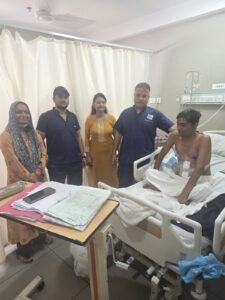
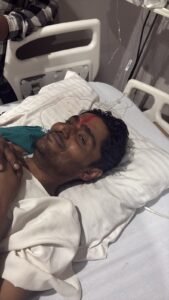
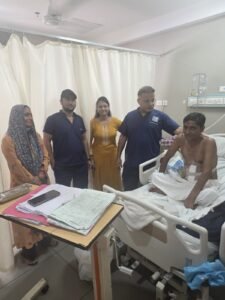
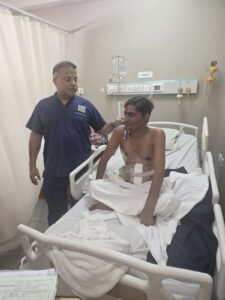
After 26 days of relentless multidisciplinary critical care, multiple surgeries, prolonged mechanical ventilation, severe sepsis, candidemia, multidrug-resistant infections, and repeated life-threatening complications, this young man walked out of the hospital with his family.
What initially appeared almost impossible had become reality—not because of one intervention, but because an entire team refused to give up.
Lessons Learned: What This Patient Taught Us
Every critically ill patient teaches us something. Some reinforce established principles, while a few redefine our approach to intensive care. This young man’s journey reaffirmed several fundamental concepts that every intensivist should keep in mind.
Physiology Before Procedures
The first and perhaps most important lesson was that physiology must be restored before
definitive intervention whenever possible.
Although the patient had a massive bronchopleural fistula requiring urgent surgical repair, immediate surgery in profound shock, severe metabolic acidosis (pH 6.8), evolving renal failure, and ischemic hepatitis would likely have carried an even higher mortality.
The initial 48 hours were therefore devoted to restoring physiology:
Optimization of tissue perfusion.
Goal-directed hemodynamic resuscitation.
Cardiac output-guided fluid therapy.
Bedside ultrasound-guided decision making.
Careful ventilator optimization.
Correction of severe metabolic derangements.
Only after achieving physiological stabilization was definitive surgery undertaken. This approach transformed an almost unsurvivable situation into one with a realistic possibility of recovery.
Monitoring Does Not Save Lives—Correct Interpretation Does
Modern intensive care provides access to sophisticated monitoring systems, but monitors themselves do not improve outcomes.
The correct interpretation of physiological data and timely therapeutic decisions are what save lives.
Repeated bedside ultrasound examinations, invasive arterial pressure monitoring, cardiac output monitoring, serial arterial blood gas analysis, and continuous reassessment enabled individualized management throughout the patient’s ICU stay.
Rather than administering empirical fluids or vasopressors, each intervention was guided by objective physiological evidence.
This individualized approach helped us restore perfusion while avoiding fluid overload.
Organ Rescue Is Better Than Organ Replacement
One of the greatest achievements in this case was preventing progression to irreversible organ failure.
Despite severe shock:
The kidneys recovered without requiring renal replacement therapy.
Severe ischemic hepatitis gradually resolved.
Progressive multiorgan dysfunction was halted before irreversible damage occurred.
Critical care should always strive to preserve native organ function whenever possible. Organ replacement therapies remain invaluable rescue tools, but preventing their need through timely physiological optimization represents an even greater success.
Less Can Sometimes Be More
Trauma patients frequently receive large volumes of intravenous fluids and blood products. Current evidence increasingly supports balanced resuscitation while avoiding unnecessary transfusion and excessive positive fluid balance whenever clinically appropriate. Using advanced hemodynamic monitoring, dynamic assessment of fluid responsiveness, serial ultrasound, and careful clinical judgment, we avoided indiscriminate fluid administration.
During the entire ICU course, the patient required only two units of packed red blood cells and two units of fresh frozen plasma.
Avoiding excessive transfusion likely contributed to better pulmonary recovery, reduced inflammatory burden, and earlier liberation from mechanical ventilation.
Source Control Cannot Be Replaced by Antibiotics
Despite broad-spectrum antimicrobial therapy and intensive supportive care, the patient continued to deteriorate until the ischemic colon and fecal peritonitis were identified and surgically treated.
This case once again demonstrated one of the most important principles in critical care:
Antibiotics support recovery. Source control enables recovery.
The timely surgical intervention by Dr. Hitesh Chawada and his team fundamentally changed the patient’s trajectory.
Nutrition, Rehabilitation, and Family Are Therapeutic Interventions
Critical care does not end with stabilization.
Recovery depends equally upon:
Early nutritional optimization.
Prevention of ICU-acquired weakness.
Early physiotherapy.
Respiratory rehabilitation.
Psychological support.
Family involvement.
The decision to encourage family presence once the patient became responsive proved invaluable.
His wife remained beside him throughout this journey. Her encouragement became part of the therapeutic process itself. Similarly, the extraordinary efforts of the physiotherapy team enabled progressive mobilization, successful ventilator weaning, avoidance of tracheostomy, and eventual functional recovery.
The True Heroes
Although this article describes physiology and clinical decision-making, this patient’s recovery belongs to an extraordinary multidisciplinary team.
My deepest appreciation goes to Dr. Bhupesh Shah Sir and his thoracic surgical team, whose courage in repairing the bronchopleural fistula under such hostile physiological conditions created the first opportunity for recovery.
My sincere gratitude to Dr. Hitesh Chawada and his surgical team for their timely recognition and decisive management of ischemic colon and faecal peritonitis, which achieved definitive source control and saved this patient’s life.
I extend my heartfelt thanks to the Respiratory Care Unit team, whose seamless coordination and safe transfer ensured continuity of critical care from the referring hospital to our ICU.
A special word of appreciation goes to Kaushal and Abhi, whose professionalism and dedication during transport were instrumental in this patient’s successful transfer.
I am immensely proud of my entire ICU team, whose commitment never wavered during these 26 demanding days.
A special note of gratitude goes to Vaishali, Nidhi, and Sachin for their tireless bedside care, meticulous monitoring, unwavering vigilance, and compassionate support. Their dedication exemplified the very best of intensive care nursing and contributed immensely to this patient’s recovery.
My sincere thanks also go to our respiratory therapists, physiotherapists, microbiology team, dietitians, technicians, and every member of the multidisciplinary ICU team. Each played a vital role in transforming critical illness into recovery.
Finally, I wish to acknowledge the patient’s wife and family.
Throughout every discussion, every difficult decision, and every setback, they demonstrated remarkable courage, trust, patience, and resilience. Their faith in the treating team inspired us to continue fighting when the outcome appeared uncertain.
Final Reflection
Critical care medicine is often perceived as a specialty dominated by technology.
In reality, technology is only one component.
Patients survive because physiology is understood, decisions are timely, surgeons are courageous, nurses remain vigilant, physiotherapists mobilize relentlessly, microbiologists guide therapy, families continue to believe, and multidisciplinary teams refuse to give up.
This patient reminded all of us that impossible outcomes are rarely achieved by extraordinary individuals; they are achieved by ordinary professionals working together with extraordinary commitment.
Twenty-six days earlier, survival appeared almost impossible.
Today, he walked out of the hospital with his family.
There can be no greater reward for an intensivist.
With warm regards and heartfelt gratitude,
Dr. Rajesh Chandra Mishra
MBBS, MD (Medicine), FNB (Critical Care Medicine), EDIC, FCCM, FCCP, FICCM, FICP
Senior Consultant – Intensivist & Internist -Sterling Hospitals, Ahmedabad
Director – Shaibya Comprehensive Care Ahmedabad, Gujarat, India
Past President, Indian Society of Critical Care Medicine (ISCCM) (2022–2023)
Past General Secretary, Indian Society of Critical Care Medicine (ISCCM) (2019–2020)
Past Chancellor, Indian College of Critical Care Medicine (ICCM) (2022–2023)
Former India Representative, European Society of Intensive Care Medicine (ESICM)
“Critical care is not merely about supporting failing organs—it is about restoring life
through physiology, teamwork, compassion, and the courage to persevere when hope appears
distant.”—RCM ..